What Is Customer Acquisition Cost (CAC)? A Beginner's Guide to Understanding How Much It Costs to Acquire a Customer
Customer Acquisition Cost (CAC) measures how much a business spends to acquire a new paying customer. Learn how CAC is calculated, what costs are included, how it differs from Cost Per Lead (CPL), and why it's one of the most important metrics for measuring sustainable business growth.

Imagine your company has just finished a successful marketing campaign.
The marketing team generated hundreds of leads.
The sales team converted several of those leads into paying customers.
Everyone celebrates the results.
Then the finance team asks an important question:
"How much did it actually cost us to acquire each customer?"
It's a simple question, but answering it is essential for understanding whether your business is growing sustainably.
Generating leads is valuable.
Closing deals is valuable.
But if acquiring customers costs more than the revenue they generate, the business may struggle in the long run.
This is why companies measure Customer Acquisition Cost (CAC).
In this guide, you'll learn what CAC is, how it's calculated, why it matters, and how businesses use it to make smarter growth decisions.
What Is Customer Acquisition Cost (CAC)?
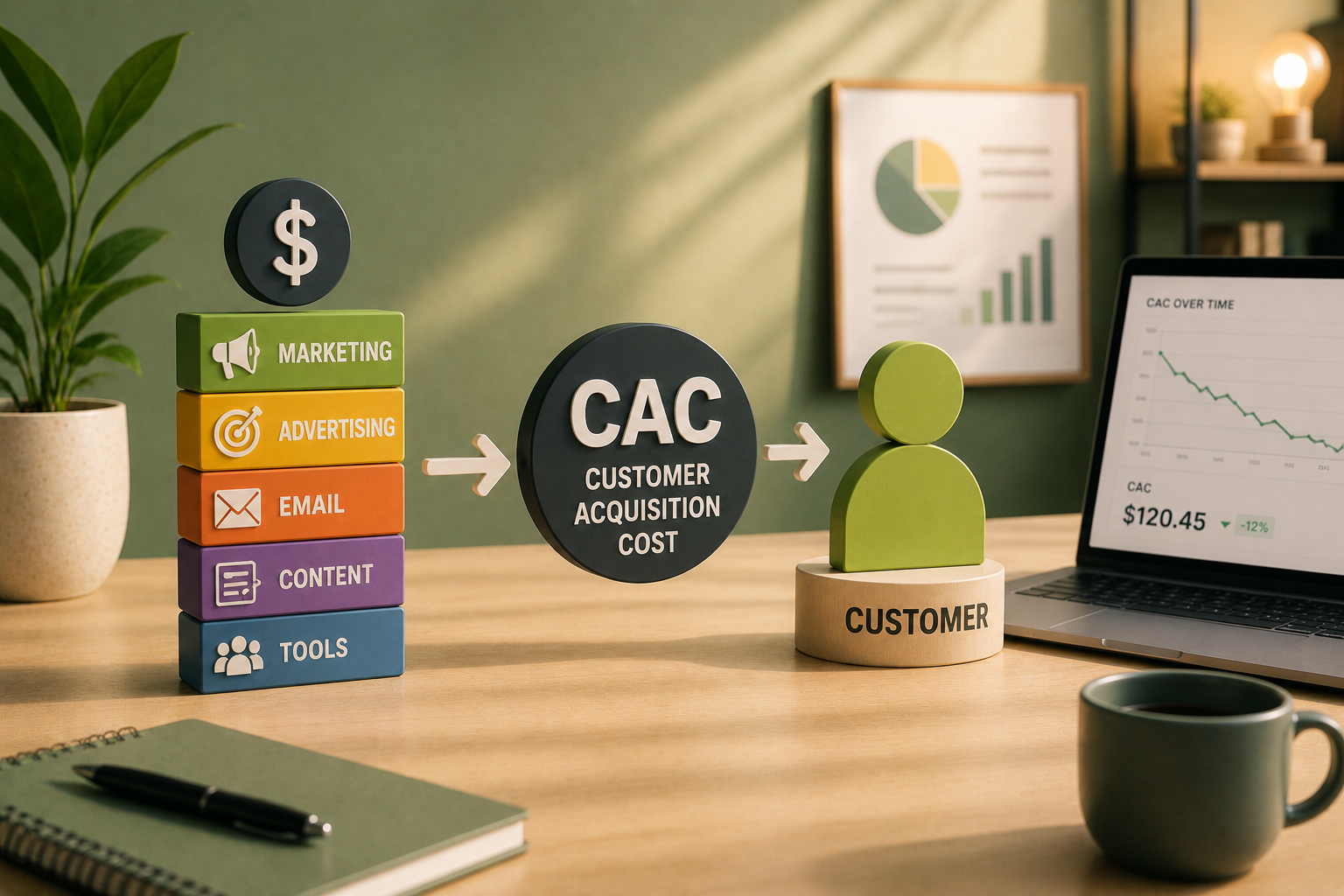
Customer Acquisition Cost (CAC) is the average amount of money a business spends to acquire one new paying customer.
In simple words, CAC answers this question:
"How much does it cost our business to turn a prospect into a customer?"
Unlike Cost Per Lead (CPL), which measures the cost of generating leads, CAC measures the cost of acquiring actual customers.
That's an important difference.
A business might generate thousands of leads, but only a small percentage will eventually become customers.
CAC focuses on the final outcome.
Let's Understand This with an Example
Imagine your company spends:
-
₹5,00,000 on marketing campaigns
-
₹3,00,000 on sales activities
During that period, the company acquires 40 new customers.
The total acquisition cost is:
₹8,00,000
Now divide that by the number of customers:
₹8,00,000 ÷ 40 = ₹20,000
Your Customer Acquisition Cost (CAC) is ₹20,000 per customer.
This means the business spent an average of ₹20,000 to acquire each new customer.
Why Is CAC Important?
Imagine two companies selling similar software.
Company A
-
CAC: ₹15,000
-
Average customer spends ₹5,00,000
Company B
-
CAC: ₹1,50,000
-
Average customer spends ₹50,000
Which business is healthier?
Probably Company A.
Even though both companies are acquiring customers, the relationship between acquisition cost and customer value is completely different.
Businesses don't just want more customers.
They want customers who generate enough value to justify the cost of acquiring them.
That's why CAC is one of the most closely watched metrics in B2B companies.
How Do You Calculate CAC?
The basic formula is:
Customer Acquisition Cost = Total Sales and Marketing Costs ÷ Number of New Customers
Let's look at another example.
A company spends during one quarter:
-
₹8,00,000 on advertising
-
₹2,00,000 creating content
-
₹6,00,000 on sales salaries
-
₹1,00,000 on CRM and marketing software
Total acquisition investment:
₹17,00,000
New customers acquired:
50
The calculation becomes:
₹17,00,000 ÷ 50 = ₹34,000
The average cost of acquiring one customer is ₹34,000.
What Costs Are Usually Included in CAC?
Different companies calculate CAC slightly differently, but it often includes expenses related to both marketing and sales.
Examples include:
Marketing Costs
-
Paid advertising
-
Content creation
-
Graphic design
-
Events
-
Content syndication
-
Marketing software
-
Agency fees
Sales Costs
-
Sales team salaries
-
Sales commissions
-
CRM software
-
Sales enablement tools
-
Product demonstrations
-
Travel expenses (if applicable)
Some businesses also include onboarding costs, while others measure them separately.
The important thing is to use a consistent method over time.
How Is CAC Different from CPL?
These two metrics are closely related, but they measure different stages of the customer journey.
Cost Per Lead (CPL) measures the cost of generating a lead.
Customer Acquisition Cost (CAC) measures the cost of converting prospects into paying customers.
Imagine this example.
A campaign generates:
-
500 leads
-
25 customers
CPL tells you how much it cost to generate the 500 leads.
CAC tells you how much it cost to acquire the 25 customers.
Both metrics are valuable because they answer different business questions.
What Can Affect CAC?
Many factors influence Customer Acquisition Cost.
Some of the most common include:
Industry
Selling enterprise software usually requires longer sales cycles than selling low-cost online services.
Longer buying processes often increase CAC.
Product Price
High-value enterprise solutions often have higher CAC because they involve more marketing, more meetings, and longer negotiations.
Sales Cycle
The longer it takes to close a deal, the more resources the business invests in acquiring that customer.
Keep Reading
You've reached the end of your free preview. Create a free account to read the rest of this article and unlock the full B2Bmedium library.